
AI-Powered Work Redesign
Transforming jobs and workflows with AI to improve employee performance. - Unlock work's full potential with AI to transform how it gets done. Our AI Workflow Assessment and Design services help organizations evaluate existing jobs and business processes to identify opportunities for AI-enabled improvements. Job redesign aims to increase employee productivity, operational efficiency, and performance. We combine work redesign methods, such as workflow analysis and human-centered design, with AI to develop practical, actionable recommendations that deliver measurable business value. Our fixed-price, rapid-assessment approach provides an affordable, low-risk starting point to identify AI-work improvement opportunities that deliver ROI.
Using elements from time-proven methods such as work sampling and time analysis, task analysis, human factors analysis, business process reengineering, and performance analysis, we analyze how staff execute daily responsibilities. Then we redesign selected job activities so that AI assistance and agent automation reduce administrative effort, improve work quality, and free employees for higher-value tasks.
We also leverage resources such as O*NET to provide occupational information, including job tasks, skills, knowledge requirements, work activities, and other characteristics, to identify and jump-start the process by matching relevant occupational task descriptions to the client's actual job description. A June 2026 O*NET research report reviewed 19 studies examining AI's impact on occupations. It found that many methods assess AI's potential by examining individual job tasks, worker skills, and occupational requirements. Evaluating each task for AI augmentation or automation potential lays the foundation for job redesign with measurable results. The major advantage of our approach is that you don't have to start every work improvement engagement from scratch.
About AI Job Performance Redesign (AI-JPR) Method - The goal of AI-JPR is to answer the following five questions:
What work does the employee perform?
Which tasks consume the most time or are the most difficult?
Which activities could be improved by using AI?
How should those activities be redesigned?
How much improvement does the redesign produce, and is there a return on investment?
The six-step AI-JPR method consists of:
Analyzing the Job to identify responsibilities, tasks, and performance expectations. This step uses job descriptions, O*NET, interviews, work observation, and job and task inventories.
Measure Current Performance - Estimate time, effort, quality, and frequency of activities. Use employee surveys, time studies, and performance data to create a current-state performance baseline.
Assess AI opportunities by evaluating tasks for AI augmentation, automation, or elimination. The AI task assessment matrix is used to assess AI opportunities and risk.
Using AI matrices and analytics task and job analysis and redesign is generated. The new design outlines how AI can assist employees for improve performance, productivity, and work quality.
Train employees on Copilot or ChatGPT on Chat, agents, and templates to pilot the AI Improvements.
Define success metrics and measure results. Compare performance before and after redesign in terms of task time, quality, cost, employee satisfaction and feedback, and produce a Productivity and Improvement Analysis. report.
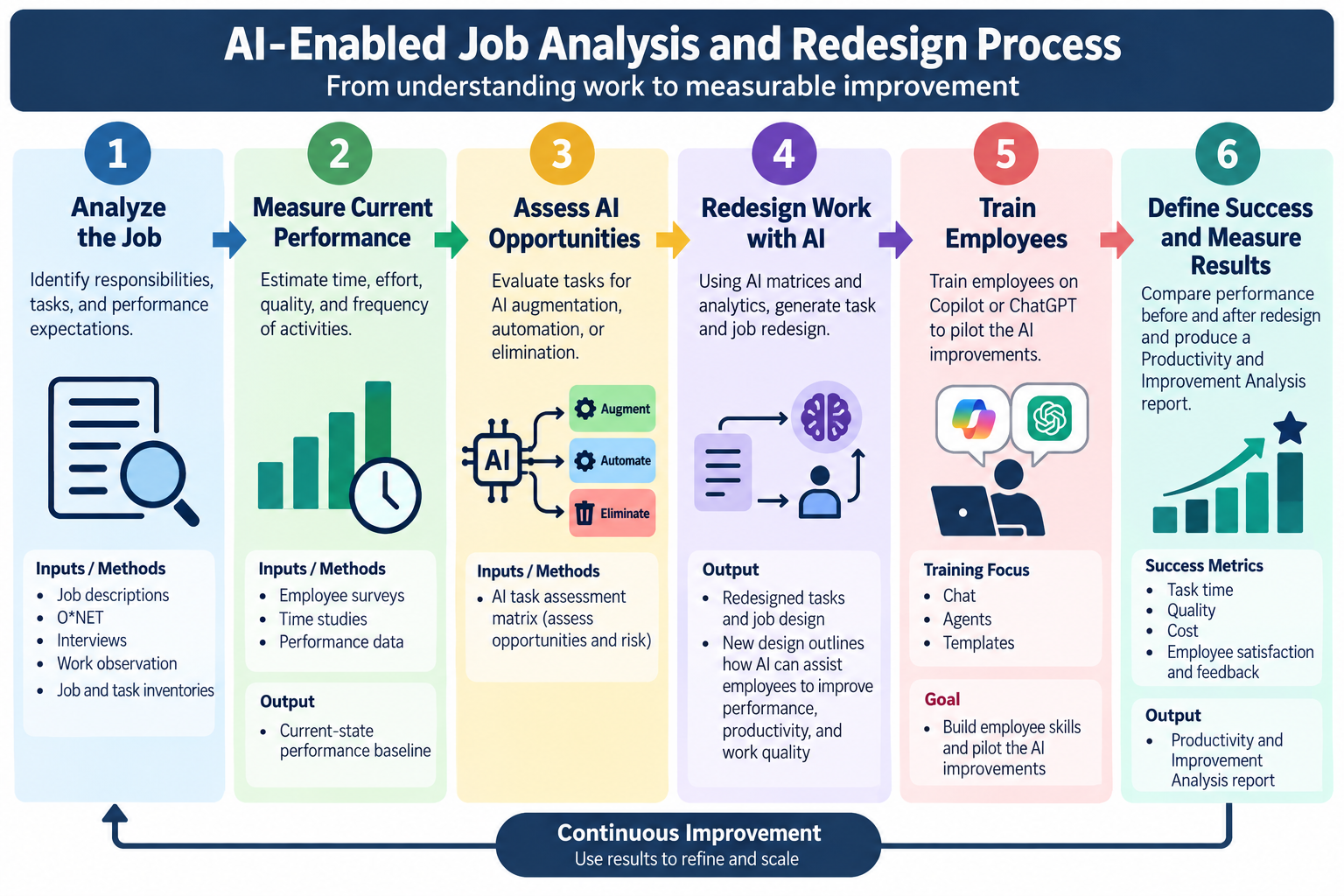
The AI-JPR process uses a AI task assessment scoring matric consisting of several dozen factors grouped into six categories as follows:
Time consumption - How much employee time does the activity require?
Repetitiveness - How frequently is the activity repeated?
Information Processing - How much research, analysis, or documentation is involved?
AI Capability - How effectively can available AI perform or assist with the activity?
Implementation Feasibility - How practical is introducing AI into the activity?
Performance Improvement Potential - How much could AI improve speed, quality, or consistency?
The assessment generates an AI Task Improvement Opportunity Score by combining these six factors and converting them to a 100-point scale that suggests opportunity level and on which action recommendations are based.
Risk of the AI implementation is separately assessed rather than averaging it into the opportunity score. A task with excellent productivity potential may still be unsuitable for automation because it involves confidential information, regulated decisions, safety, or consequential human judgments. The final assessment result is a two-dimensional decision matrix. AI improvement opportunity: Low, medium, or high. Implementation risk: Low, medium, or high. to help clients understand which activities to improve first.
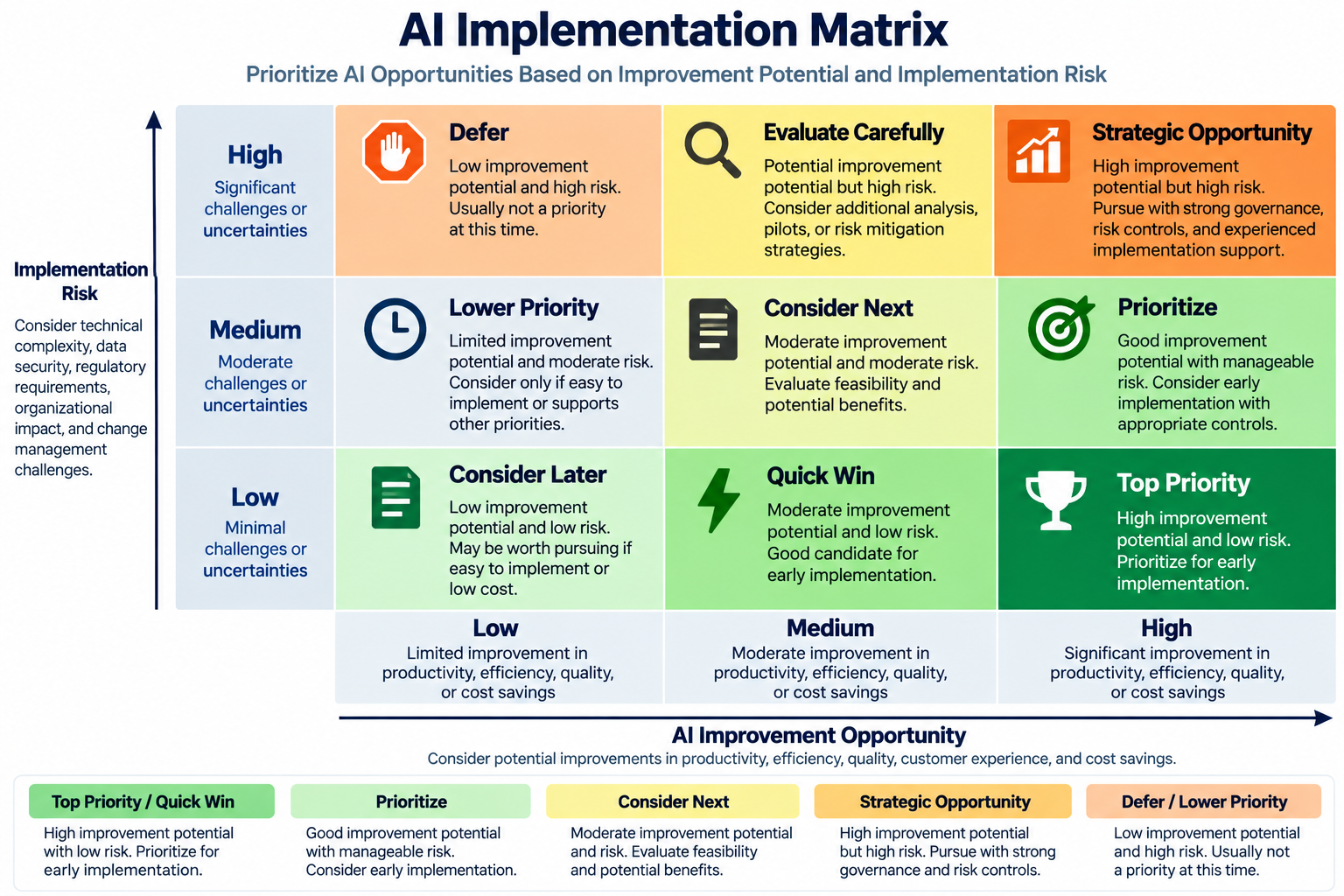
Redesign, Automation, or Elimination - We do not assume that every activity needs an AI solution. For each task, five possible outcomes are considered: (1) importance in decision-making, (2) is the activity unnecessary and can be eliminated, (3) can the task be simplified and improved without AI, (4) can AI assist the employee to perform the task, (5) can the task use AI Automation to perform the activity subject to appropriate controls and human oversight. It is critical to retain human oversight when the task requires human judgment, relationships, accountability, or other capabilities that should remain with the employee. The news is filled with poorly designed AI agents that exclude human review and approval, causing organizational performance, financial, and reputational damage.